Why Forbetra
You cannot become what you cannot see.
We set goals, make plans, and measure performance. But how do we really know we're improving?
Some goals, like a target weight or total sales, are easy to measure. Others, like executive presence or competitiveness, are not. Harder still, how others think we are doing often matters as much as how we are actually doing.
If perception is reality, how do you find out what others really think? Given the time and money we invest in coaching and development, how do we know we're getting a return?
Before Forbetra, we couldn't. Now we can.
Four principles
01
Important goals are not always directly measurable.
Executive presence, competitiveness, leadership impact. They are real, and no single conventional metric captures them.
02
Development becomes trackable through what people do.
Change shows up in effort and in performance. Both can be rated consistently, which makes an abstract goal concrete. We track perceptions, honestly labeled as perceptions.
03
Effectiveness includes how others experience you.
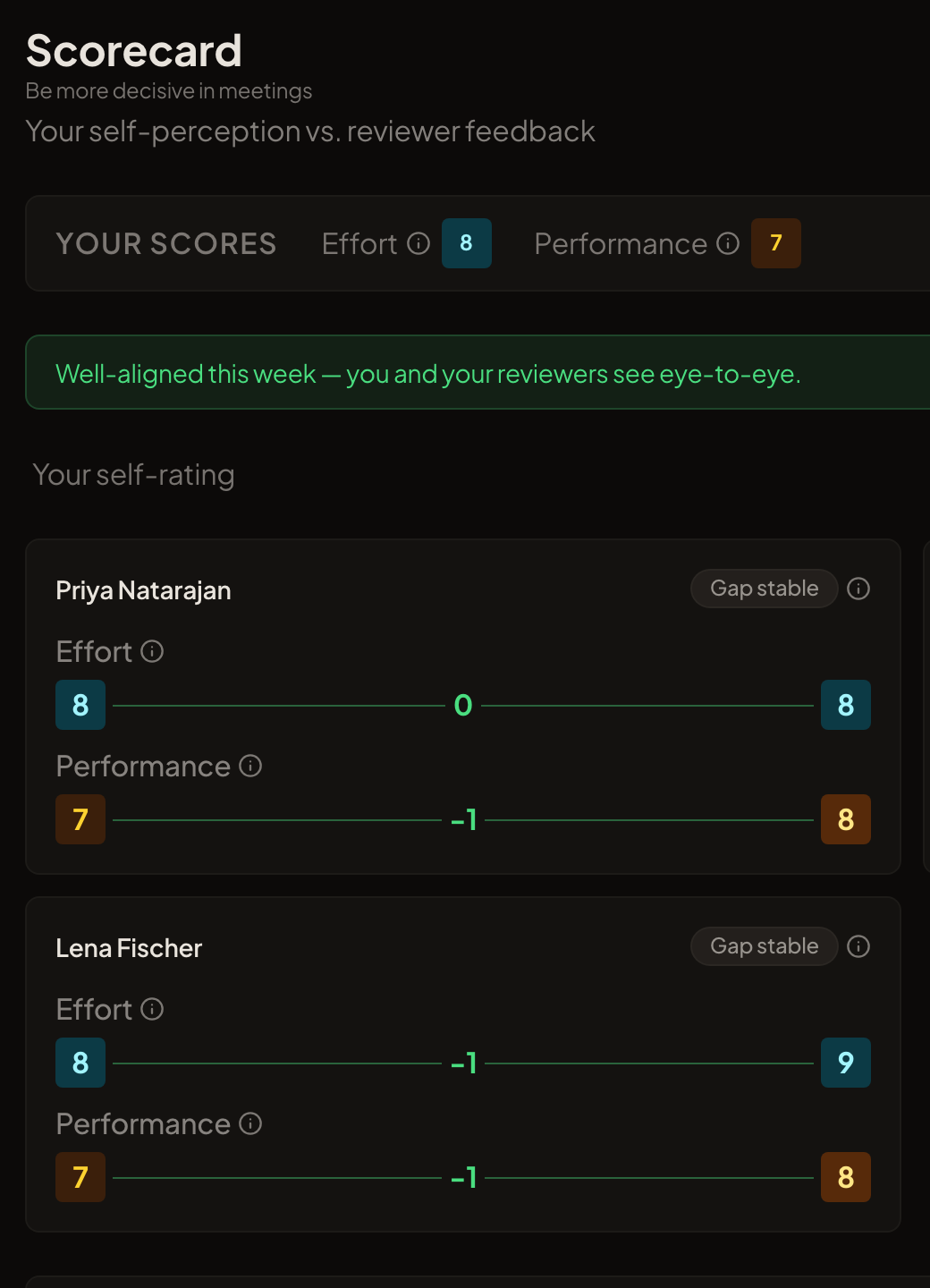
Your own view matters. So does how others perceive your effort and performance. The gap between the two views is where the insight lives.
04
Progress is revealed over time.
Rated consistently, by you and by the people around you, development becomes visible, actionable, and provable.
What we measure, honestly
Structured perception, not a pretend KPI.
For goals that can't be measured objectively, Forbetra doesn't pretend to capture ground truth. It measures two subjective ratings, effort and performance, from you and from your reviewers, on a repeating weekly rhythm.
The difference between the two perspectives, and how it moves across a twelve-week journey, is the product. That is the bridge from "we couldn't measure progress on soft goals" to "now we can."
If you need a category for it: a continuous, lightweight 360 for the goals a 360 cannot score, with no anonymity and no HR form.
Reviewers are people
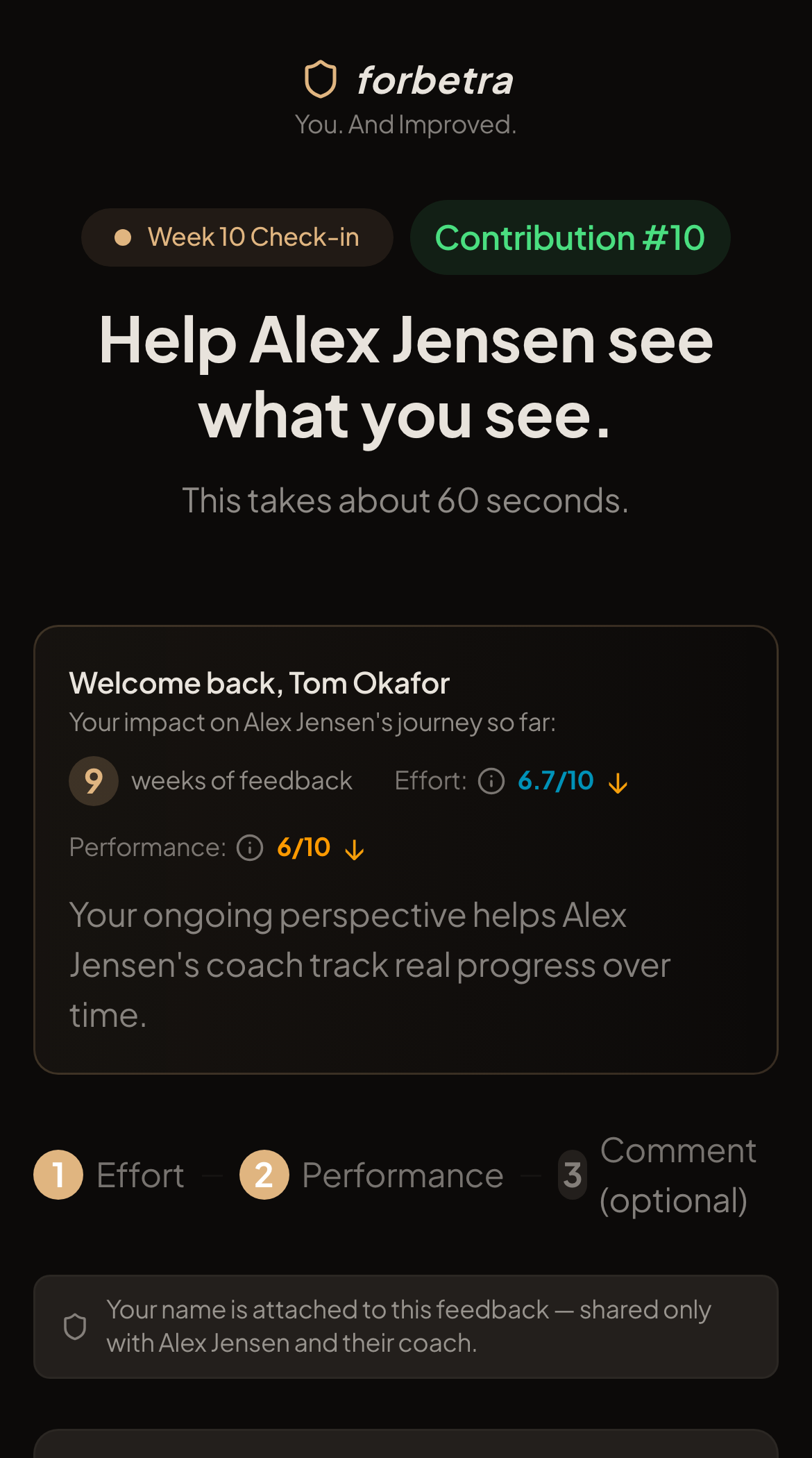
Sixty seconds. No account. Never more than weekly.
The whole loop depends on reviewers staying willing. So the ask is tiny, the link opens straight to two ratings, the person who invited them can set them to every other week, and after they submit they see how their view compared.
What a reviewer is asked to do
Who's behind it
Built by Winning Mind, a performance psychology practice that builds software.
Forbetra comes from twenty-five years of coaching executives, athletes and operators. The product encodes what that work taught us about measuring the unmeasurable.

Marc Sagal
Managing Partner
Executive coach and sport psychology consultant. Marc has spent his career helping leaders and athletes define meaningful success and get there, with work featured on FOX Sports and in national press. Forbetra grew out of a frustration he kept meeting in that work: the goals that mattered most to his clients were the ones nobody could measure.

Dr. Mark Lowry
Managing Partner
Licensed clinical psychologist who served on active duty as a U.S. Army psychologist for over eight years, including assignments with the 160th Special Operations Aviation Regiment and Delta. His work in selection, assessment and operational support shapes how Forbetra approaches focus under pressure.
-
Kieran Buckley
Development Partner
Kieran builds Forbetra: the product, the data model, and the AI that turns twelve weeks of ratings into a coaching conversation. Full bio to come.
One goal. Twelve weeks. A record instead of a feeling.
Start a journey on your own, or talk to us about a cohort.
Individuals can start free today. Coaches and organizations are priced per participant per journey; reviewers are always free.